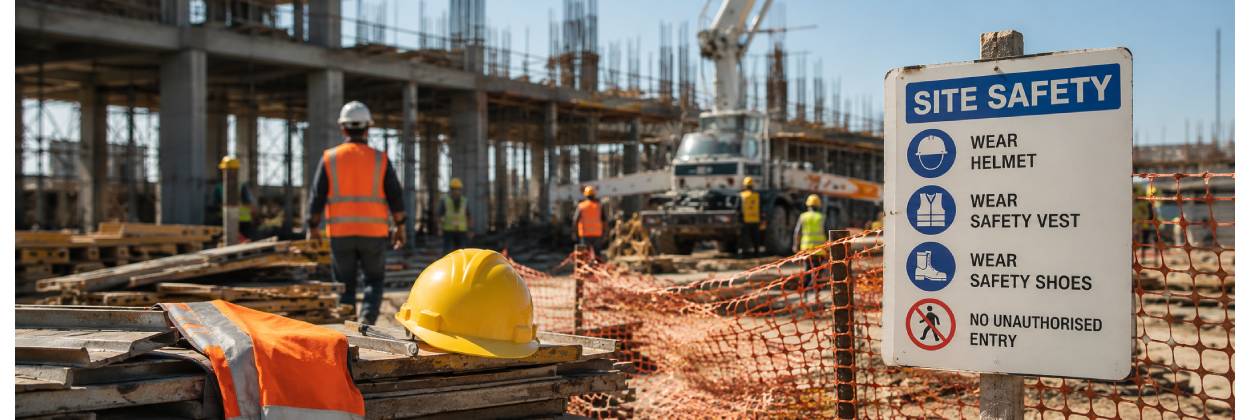
Practical safety practices that protect your workers, your timeline and your budget on every site.
Key takeaways
- Safety is not a cost — accidents and delays are far more expensive.
- PPE, housekeeping and trained supervision prevent most common incidents.
- A safe site is usually a well-managed, on-schedule site.
A safe construction site protects people first — and it protects your project too. Incidents cause delays, disputes and cost. Good safety practice is simply good project management.
If you are having a house built, site safety is not only the builder’s concern. As the person commissioning the work you have a practical interest in it, and a walk around the site tells you a great deal about how well your project is being run.
The fundamentals
- Personal protective equipment (PPE) for everyone on site.
- Clear, tidy access routes and good housekeeping.
- Proper scaffolding, edge protection and safe ladders.
- Trained supervision and clear daily briefings.
- Secure storage and safe handling of materials.
A clean site is a safe site. Most slips, trips and falls come down to housekeeping.
The risks that matter most on Indian residential sites
Serious incidents on small and mid-sized building sites cluster around a short list of causes. Knowing them tells you what to look for:
- 1Falls from height — the single largest cause of serious injury. Scaffolding, edge protection at slab level and stair openings deserve the closest attention.
- 2Falling material — bricks, tools or debris dropped from an upper level onto people below, which is why access below active work should be controlled.
- 3Electrical contact — temporary site wiring is often the most improvised system on a site, and the most dangerous.
- 4Excavation collapse — deep foundation trenches in loose or waterlogged soil need shoring; this is a real risk in low-lying parts of Chennai.
- 5Manual handling injuries — the slow, cumulative kind that rarely get reported but steadily reduce a crew’s capacity.
Monsoon changes the risk picture
Chennai’s rain introduces hazards that are absent for most of the year, and they arrive quickly once the north-east monsoon sets in:
- Excavations fill and trench walls soften, raising collapse risk substantially.
- Scaffolding boards and slab surfaces become slippery.
- Temporary electrical connections and standing water are a dangerous combination.
- Stored cement spoils, and steel left exposed begins to rust.
- Access routes turn to mud, which slows every material movement on site.
A builder who plans around the monsoon — sequencing structural work outside the heaviest weeks and protecting stored material — is managing both safety and your schedule at the same time.
What to look for when you visit your site
You do not need technical training to read a site. These signals are visible to anyone:
- Are workers wearing helmets and footwear, and is anyone at height using a harness?
- Is scaffolding properly tied and braced, or improvised from whatever was available?
- Are stair and slab openings guarded, or open holes anyone could step into?
- Is the site tidy, with materials stacked rather than scattered across walkways?
- Is temporary wiring run properly, or are bare joints lying in the open?
- Is there drinking water, shade and a clean place for the crew to eat?
That last point matters more than it appears. Sites that look after their workers tend to keep the same crew for the length of the project, and continuity of crew is one of the strongest predictors of consistent workmanship.
Safety and schedule go together
Well-run sites tend to be both safer and faster. When access is clear, materials are organised and the team is briefed, work flows smoothly and milestones are met. Cutting corners on safety almost always costs time in the end.
The reverse is equally reliable. A chaotic site — materials everywhere, no supervision, improvised access — is rarely producing careful work out of sight. What you can see on the surface is usually a fair indication of what is being buried in the concrete.
Frequently asked questions
Why is site safety important?
It protects workers from harm and protects your project from the delays, disputes and costs that incidents cause. Safe sites are usually well-managed, on-schedule sites.
What basic safety measures should every site have?
PPE for all workers, good housekeeping, proper scaffolding and edge protection, trained supervision, and safe material storage and handling.

Written by
Arjun Mehta
Lead Civil Engineer, KN Builders